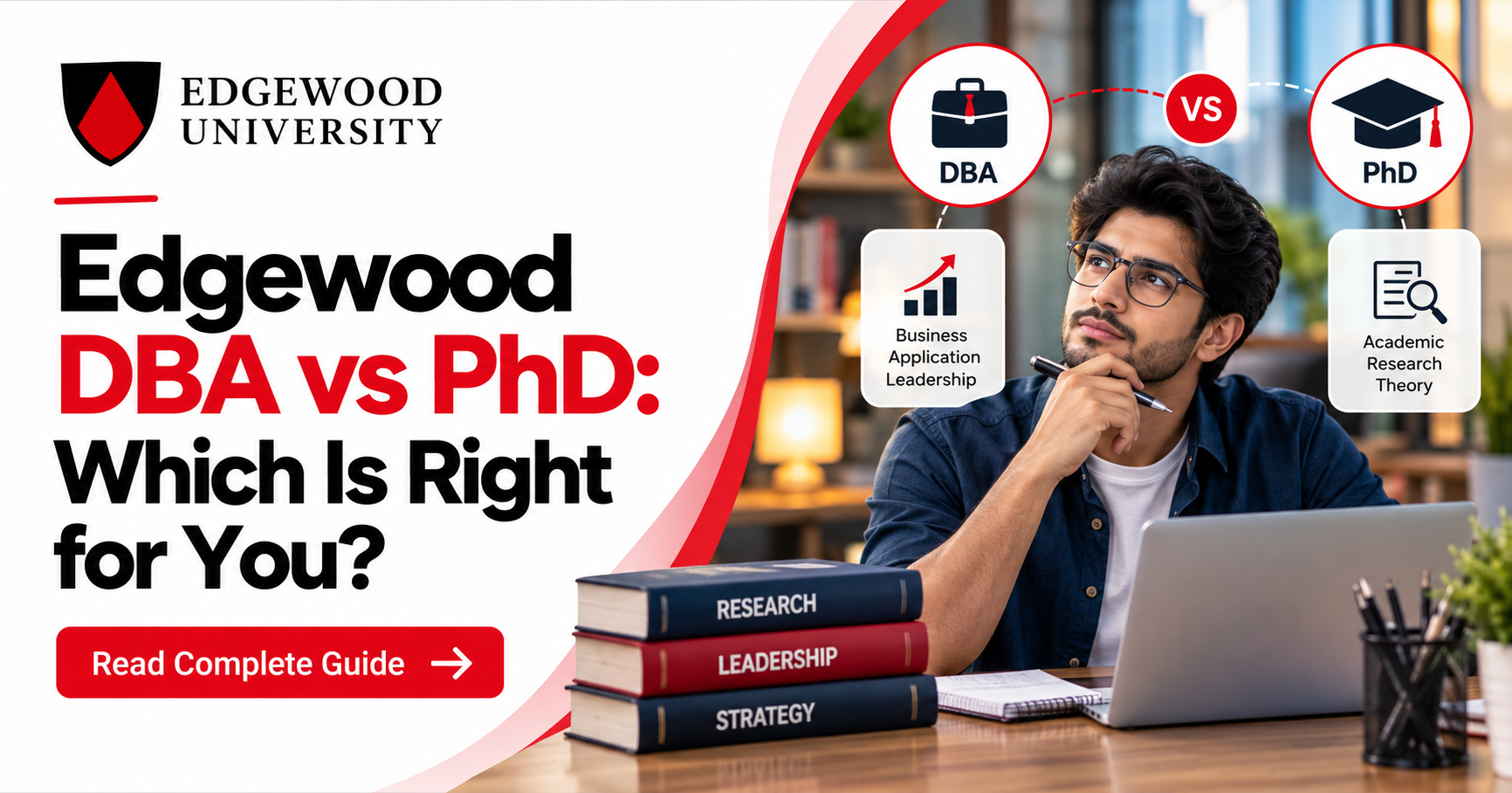
Choosing between a Doctor of Business Administration and a Doctor of Philosophy can be an important decision for professionals planning to advance their careers in business, management, consulting or academia. Both are doctoral-level qualifications, but they generally differ in their research focus, learning objectives and intended career pathways.
Edgewood University offers a Doctor of Business Administration programme designed to help professionals apply research to real-world business challenges. Its curriculum emphasises leadership, analytical thinking, organisational decision-making and evidence-based solutions.
But is an Edgewood DBA better than a PhD? The answer depends on your career goals. If you want to solve business problems and strengthen your leadership capabilities, a DBA may be suitable. If you want to focus on theoretical research and build an academic research career, a PhD may be a better fit.
This guide compares the Edgewood DBA with a traditional business or management PhD to help you make an informed decision in 2026.
What Is the Edgewood DBA Programme?
The Doctor of Business Administration at Edgewood University is a doctoral programme focused on applying research to practical business and management challenges.
The university’s published programme information describes an online study option and highlights the development of scholar-practitioner expertise. Students learn to investigate complex organisational problems, evaluate evidence, improve decision-making and communicate research findings effectively.
Edgewood lists the following DBA concentrations:
- Financial
- General
- Leadership Excellence
The programme is designed for candidates who want to connect doctoral-level research with professional practice. Potential career pathways include corporate leadership, business consulting, strategic planning and other senior management roles.
Edgewood’s official programme information also states that its DBA is accredited through the Higher Learning Commission. It describes the programme as being in candidacy with the Accreditation Council for Business Schools and Programs, or ACBSP. These are different accreditation statuses, so applicants should check the latest institutional disclosures before enrolling.
Important distinction: Edgewood University’s published programme catalogue identifies its Doctor of Business Administration. This comparison does not imply that Edgewood currently offers a business PhD. The PhD discussed below is a general comparison with doctoral programmes offered by other institutions.
Edgewood DBA vs PhD: Key Differences
A DBA and a PhD can both involve advanced research, independent investigation and a substantial final research project. The main difference is usually the purpose of the research and how it relates to professional practice.
| Comparison Factor | Edgewood DBA | Traditional Business or Management PhD |
|---|---|---|
| Full Form | Doctor of Business Administration | Doctor of Philosophy |
| Main Focus | Applied business research and professional practice | Theoretical, empirical and original academic research |
| Research Orientation | Investigating organisational challenges and developing practical solutions | Advancing knowledge, theory and scholarly understanding |
| Typical Audience | Experienced professionals, managers, consultants and business leaders | Aspiring academics, researchers and subject specialists |
| Research Topics | Leadership, finance, organisational performance and business decision-making | Management theory, organisational behaviour, economics, strategy and related disciplines |
| Learning Approach | Combines doctoral research with professional application | Commonly emphasises research training, academic literature and independent investigation |
| Final Research Work | Doctoral dissertation or applied research project, according to programme requirements | Doctoral dissertation or thesis based on original research |
| Potential Career Paths | Corporate leadership, consulting, strategic planning and applied research | University research, academic teaching, research organisations and specialist roles |
| Programme Structure | Edgewood’s published DBA is available online | Structure and delivery depend on the university |
| Best Fit | Professionals seeking to apply research in business settings | Candidates seeking intensive research training and academic scholarship |
These are general differences rather than universal rules. Some PhD programmes include applied research, and many DBA programmes require substantial original scholarly work.
1. Research Focus: Applied Business Problems vs Academic Theory
Research is central to both degrees, but the type of question you want to investigate can help determine which programme is more suitable.
Edgewood DBA: Research for Business Practice
The Edgewood DBA focuses on using research to investigate current and emerging business challenges.
For example, a senior manager might study why employee turnover is increasing across different departments. The research could examine leadership practices, workplace policies and employee feedback before developing evidence-based recommendations.
Other possible research areas include financial decision-making, organisational change, strategic planning and business performance.
The goal is to produce rigorous research that can inform professional decisions and organisational improvements.
PhD: Research to Advance Knowledge
A PhD in business or management generally places greater emphasis on developing original scholarly knowledge.
A PhD candidate might investigate how leadership theories explain employee behaviour across different organisational settings. The research may test existing theories, develop a new conceptual framework or examine relationships that have not been sufficiently studied.
The goal is to make an original contribution to the academic discipline.
Which Research Style Should You Choose?
If you want to investigate a problem you encounter in your organisation and use the findings to improve business practice, a DBA may be appropriate.
If you enjoy theoretical questions, academic literature, research design and developing knowledge that other scholars can build upon, a PhD may be a better match.
However, the final choice should depend on the actual research expectations of each programme, not just the degree title.
2. Eligibility: Who Should Consider Each Degree?
Entry requirements vary by university, programme and admission pathway. Candidates should review the official requirements before applying.
Eligibility for Edgewood DBA
Edgewood’s published DBA admissions information generally requires applicants to hold a master’s degree from an appropriately accredited or equivalent institution. Its standard admission guidance also specifies an academic performance requirement, with conditional admission potentially available in some cases.
An MBA is not compulsory. Edgewood states that candidates with a master’s degree in another discipline may also apply, subject to the programme’s requirements.
Applicants should prepare to provide the documents requested by the university, including official academic transcripts and a completed graduate application.
Eligibility for a PhD
PhD eligibility depends on the institution and the programme’s academic structure.
Some business PhD programmes accept candidates with a relevant master’s degree, while others consider applicants with a bachelor’s degree for an integrated or direct-entry route. Research experience, academic performance, references, research interests and standardised tests may also be relevant.
Unlike a DBA designed around experienced professionals, some PhD programmes prioritise academic preparation and research potential over senior management experience.
Which Is More Suitable for Working Professionals?
A DBA may suit an experienced professional who wants to pursue doctoral research while maintaining a career. Edgewood’s online study option may provide additional flexibility, although students should confirm the workload and expected completion schedule.
A PhD may also be possible while working, depending on the institution and mode of study. However, some PhD programmes require substantial time for research, seminars, teaching or on-campus participation.
3. Programme Structure and Duration
The duration of a doctorate depends on its structure, the student’s progress and the institution’s regulations.
Edgewood’s published DBA information describes a 45-credit programme and states that students may complete it in as few as 24 months. The actual time required can vary according to academic progress, course availability and the student’s workload.
A traditional business or management PhD commonly takes several years to complete. The timeline may include research methodology, advanced coursework, qualifying examinations where applicable, dissertation research and a final defence.
| Programme Stage | Edgewood DBA | Traditional PhD |
|---|---|---|
| Initial learning | Doctoral business and management coursework | Research training and, where applicable, advanced subject coursework |
| Research preparation | Research-related coursework and applied problem development | Research design, literature review and development of a scholarly question |
| Main research | Investigation of a business or management challenge | Original research designed to advance academic knowledge |
| Final submission | Dissertation or doctoral research project according to programme rules | Dissertation or thesis under the university’s research regulations |
| Completion time | Edgewood advertises completion in as few as 24 months | Varies widely by institution and research requirements |
Do not assume that all DBA programmes take two years or that every PhD requires the same number of years. Review the published structure of the programme you are considering.
4. Career Scope After an Edgewood DBA
A DBA can be valuable for professionals who want to combine research skills with leadership and business expertise.
Edgewood identifies potential career directions that include executive leadership, corporate management, strategic planning, business consulting and related senior professional roles.
Corporate Leadership
Professionals may use their doctoral research to support strategic planning, organisational improvement and evidence-based decision-making.
Possible positions include business unit leader, strategy director or senior operations manager, depending on previous experience and employer requirements.
Business Consulting
Consultants can apply research skills to examine organisational problems, evaluate business strategies and develop recommendations for clients.
A DBA may strengthen research capability, but consulting opportunities also depend on industry knowledge, professional reputation and client experience.
Entrepreneurship
Business owners may use doctoral research to investigate customer behaviour, organisational growth, innovation and business strategy.
The value of the qualification depends on how effectively the research is applied to real business decisions.
Teaching and Academic Roles
A DBA may support applications for certain business teaching positions, depending on the institution’s requirements. However, it does not automatically qualify every graduate for a permanent university faculty position.
Universities may consider research publications, teaching experience, subject expertise and the specific requirements of the advertised role. Some research-intensive academic positions may strongly prefer or require a PhD.
5. Career Scope After a Business or Management PhD
A PhD is often a strong option for candidates interested in academic research and scholarly careers.
University Teaching and Research
PhD graduates may pursue academic roles involving research, teaching, publication and supervision. Eligibility depends on the institution, subject area and applicable appointment requirements.
Research Institutions
Some graduates work in research organisations, policy institutes, economic research centres or corporate research teams.
These positions may require specialised research methods, publication experience and subject expertise.
Academic and Scholarly Publishing
A PhD can prepare candidates for research-focused work involving literature reviews, empirical analysis, scholarly writing and publication.
Industry Research and Analytics
Some PhD graduates apply their research skills in consulting, economics, organisational research, market analysis or advanced analytics roles.
A PhD does not restrict graduates to academia. The relevance of the research topic and transferable skills can also matter in industry.
6. Can You Become a Professor With an Edgewood DBA?
A DBA graduate may be eligible to apply for certain teaching or academic positions, but eligibility depends on the hiring institution and the role.
Edgewood lists college professor among the possible career directions for its DBA graduates. This should be understood as a potential career pathway rather than a guarantee of appointment.
Academic employers may evaluate:
- The qualification and institution awarding it
- Research publications and scholarly contributions
- Teaching experience
- The subject being taught
- Professional and industry experience
- Any additional academic or regulatory requirements
If your main objective is to become a professor at a research-intensive university, compare the academic hiring criteria for your target institutions before choosing a doctorate.
If your goal is to teach business subjects while bringing substantial industry experience into the classroom, a DBA may be worth considering, provided it meets the employer’s requirements.
7. Which Degree Is Better for Research?
Neither degree is automatically superior in every research context. The better choice depends on the research you want to conduct and the career in which you intend to use it.
A DBA generally emphasises applying research to professional challenges. This can be useful when your research question arises from business operations, leadership decisions or organisational performance.
A PhD generally provides intensive preparation for independent scholarly research. It may be a better fit if you want to develop academic theory, publish research papers and pursue a research-intensive academic career.
Before enrolling, examine the programme’s methodology modules, faculty expertise, dissertation expectations, publication opportunities and research supervision arrangements.
8. How to Choose Between Edgewood DBA and a PhD
Use your long-term objective as the starting point.
| Your Goal | Option to Consider |
|---|---|
| Improve business decision-making through research | Edgewood DBA |
| Apply research to organisational challenges | Edgewood DBA |
| Continue working while pursuing an online doctorate | Edgewood DBA, after confirming workload and schedule |
| Develop a career in academic research | A suitable business or management PhD |
| Focus on academic theory and original scholarly contributions | A suitable PhD |
| Pursue senior corporate leadership | DBA or PhD, depending on the role and your experience |
| Apply for university teaching roles | Compare the specific institution’s qualification requirements before choosing |
| Build a career in research-intensive academia | Usually consider a relevant PhD pathway first |
A DBA can be suitable for someone with substantial professional experience who wants to connect doctoral research with management practice. A PhD may be more appropriate for a candidate whose primary goal is scholarly research.
9. What Should You Check Before Enrolling at Edgewood?
Before applying, review the programme’s academic and institutional details.
First, confirm the exact qualification being awarded and the institution responsible for the degree. Read the current programme description rather than relying solely on information from third-party enrolment partners.
Second, verify the accreditation status. Edgewood’s official information identifies Higher Learning Commission accreditation for its DBA and separately describes ACBSP candidacy. Do not interpret candidacy as full programme accreditation.
Third, review the curriculum, credit requirements, research expectations and likely completion schedule. Ask about supervision, dissertation assessment and the support available to online students.
Finally, consider how the qualification fits your intended career. If you plan to use the degree outside the United States, check the requirements of employers, universities or relevant authorities in your intended country.
These checks can help you assess whether the programme matches your academic and professional objectives.
Conclusion
The choice between an Edgewood DBA and a PhD depends on your research interests and long-term career plans.
Edgewood University’s DBA focuses on applying research to business and management problems. Its online option may suit professionals who want to develop research capability while continuing their careers.
A traditional business or management PhD generally places greater emphasis on original scholarly research and can be a strong pathway for candidates targeting research-intensive academic careers.
Neither qualification guarantees a particular job, promotion or academic appointment. Before deciding, compare the research focus, curriculum, completion requirements and recognition of the specific programmes you are considering.
If your goal is to improve business practice through research, the Edgewood DBA may be worth exploring. If your main ambition is to develop an academic research career, investigate suitable PhD programmes and their faculty hiring expectations.
Frequently Asked Questions
1. What is the main difference between Edgewood DBA and a PhD?
The Edgewood DBA emphasises applied business research and practical organisational challenges. A traditional business or management PhD generally focuses more heavily on original scholarly research and advancing academic knowledge.
2. Does Edgewood University offer a PhD in Business?
Edgewood University’s published programme catalogue identifies a Doctor of Business Administration. This article compares that programme with the general PhD pathway offered by other institutions and does not imply that Edgewood currently offers a business PhD.
3. Is an Edgewood DBA suitable for working professionals?
The programme includes an online study option and is designed around applied business research. Professionals should still review the coursework, research workload and expected completion timeline before applying.
4. How long does the Edgewood DBA take to complete?
Edgewood advertises that its 45-credit DBA may be completed in as few as 24 months. Actual completion time depends on course availability, academic progress and the student’s ability to manage the workload.
5. Do I need an MBA to apply for the Edgewood DBA?
No. Edgewood states that applicants with a master’s degree in another discipline may also apply, provided they meet the programme’s admission requirements.
6. Can I become a professor after completing the Edgewood DBA?
Potentially, depending on the academic role and employer requirements. Universities may consider teaching experience, publications, subject expertise and the qualification required for the position. A DBA does not guarantee a faculty appointment.
7. Which is better for academic research, a DBA or a PhD?
A PhD is generally the more direct pathway for candidates who want a research-intensive academic career. A DBA may also involve substantial research but typically focuses more on applying research to professional practice.
8. Is a DBA equal to a PhD?
Both are doctoral-level qualifications, but they can differ in purpose, research design and programme requirements. Their suitability and acceptance depend on the institution, employer and context in which the qualification is being evaluated.
9. Does Edgewood’s DBA have institutional accreditation?
Edgewood’s official programme information states that its DBA is accredited through the Higher Learning Commission. The university separately describes its DBA programme as being in candidacy with ACBSP, which is not the same as full ACBSP accreditation.
10. How should I decide between an Edgewood DBA and a PhD?
Consider whether you want to apply research to business practice or focus on academic scholarship. Then compare the specific programmes’ curriculum, research supervision, completion requirements, institutional status and relevance to your intended career.